I know I am in for a treat when my friend Soulmate Sarah puts a link on my facebook page and says "BOOKCLUB?" Sovietstan was such a book. We both have a love for the slightly more obscure European countries - I lean more eastern european and she leans a little more central Asian/south eastern european but this book had something for both of us. And even if you don't have a strange niche like Souldmate Sarah and I do, I still think this is a book you could enjoy! These countries are often punchlines, if thought about at all - and most Americans can't even find them on a map but they are intriguing enough to fill several books.The countries that the book covers are: Turkmenistan, Kazakhstan, Tajikistan, Kyrgyzstan, and Uzbekistan.
Here's some interesting tidbits from the book:
- Even though we tend to lump all of the "-stan" countries together they are incredibly different from each other in so many ways (geographically, politically, economically). Turkmenistan is 80% dessert, Tajikistan is 90% mountains. Kazakhstan has become super wealthy due to oil, gas and minerals. Turkmenistan and Uzbekistan have dictatorships on par with North Korea but Kyrgyzstan people have deposed to presidents.So, let's not lump.
- Ashgabat in Turkmenistan has the most marble clad building per square kilometer in the world. (The people at Guinness say so).
- The losses that Kazakhstan had during WWII fighting as part of the Soviet Union were monstrous. 10% of the Kazakh population died in connection with "The Great Patriotic War" a loss comparable to Germany's.
- There are 1400 leftover Soviet nuclear warheads in Kazakhstan - making it one of the world's nuclear powers...which is...weird.
- At anytime between 1 and 2 million of Tajikistan's 8 million residents is in Russia working and sending the money back home. Not much work to be had in Tajikistan.
- Kyrgystan is the only post-Soviet country in Central Asia where a sitting president has stepped down of his own volition
There's also a chapter about bride kidnapping - which is awful and terrifying and messed me up for days.
This was a really interesting book that expanded my knowledge of this part of the world exponentially. Special shoutout to my local public library who didn't have this book and ordered it to have in the collection specifically for me :) All the heart eyes.
This book will have a special place in my reading history as the first book that I started and finished during quarantine! I might have to make a special shelf for that on my goodreads page :)
This books is large, more than 500 pages but chapters are shortish and self contained. They are also in chronological order so you could do some skipping around if you would like and it won't hinder you. It starts way way back in the day with the OG of doomed architectural projects - Tower of Babel and ends (almost) with the World Trade Center/One World Trade. (Hello all the feelings on that chapter). If you're like "Wesley, Im not a structural engineer - I don't care about i-beams and load bearing walls" I would say do not fret my friend, it is a book more focused on the historical than the logistical and engineeri..cal.
Here are a few of my favorite tidbits:
- The Russians took a bunch of artifacts from the excavation of Troy in Turkey at the end of World War II as trophies, you can find them in the Russian State Museum.
- So many interesting facts about the Library of Alexandria: if you were coming into the city and you had a book you had to immediatley report to the library and if they didn't already have that book you had to hand it over. They would copy it and you would get the copy back and they would keep the original. Which is such a hard librarian flex. I hate it but respect it haha.You gotta have a plan if you want a copy of every book ever made, right?
-Did you know that a "milestone" is a symbolic central point of a city from which all of the distances within the city is measure from? Like if I was like "how far is it from Rome to Florence?" the distance is measured from their milestones.
-St Paul's Cathedral is the first English cathedral to be completed within the lifetime of it's original designer
-The guy who designed the Bastille in Paris was it's first prisoner - accused of, among other things, sexual acts with a Jewish woman
-There's a whole chapter on Panopticon prisons and it's bananas
-If you look at Berlin from space you can still see the divide where the Wall was - some will say it's because of the different street lamp lights, some will say it's because of standing economic differences #probsboth.
I really liked this book, it was a good friend during a weird time. 4 out of 5 stars!
Ready Player One by Ernest Cline - I can see why so many people like this book. 80s nostalgia, a likeable protagonist, big faceless corporations are the bad guys, good world building. I also thought I was the only person who ever saw Ladyhawke, a personal favorite, until this book so #solidarity.
The Paper Menagerie and Other Stories by Ken Liu - This is a great little short story collection, with the connector between them all being something of the Asian variety. Set in Japan, a Japanese spaceship, an Asian folktale, Asian mobsters, etc etc. The titular story had me with tears in my eyes, eating my lunch at work. I want a paper menagerie to play with!
Tulip Fever by Deborah Moggach - Interesting setting, ok plot, underwhelmed by character development which made it hard to get invested in the characters.
The Pyschopath Test: A Journey Through the Madness Industry by Jon Ronson - If I had been more on the ball this one would have gotten full review, but I had to get it back to the library before I got around to writing the review. Whoops! I LOVED this book, and I can't wait to find more books by this author. It scratches that Mary Roach itch for me :)
The Poet and the Vampyre: The Curse of Byron and the Birth of Literature's Greatest Monsters by Andrew McConnell Stott - This book was too much "oh my gosh, these people are ridiculous and make all of these problems for themselves while hurting everyone around them. Gosh, are they awful" and less "so, you want to hear about "Frankenstein"? Though I did pick up some tips on how to be an efficient grave robber, so that's helpful. If you are looking for a book with scandal and intrigue, this may be the book for you!
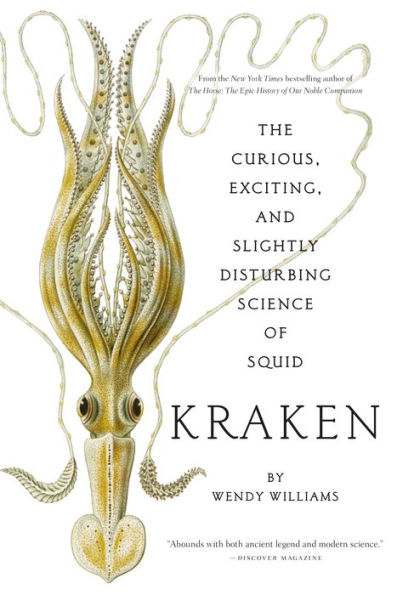
I recently read the book "Kraken: The Curious, Exciting, and Slightly Disturbing Science of Squid" by Wendy Williams. And I will tell you, the name delivers.
Here were a couple of my favorite take aways:
- Squid/Octopi could be clutch in developing treatments for neurological disorders. I saw so many words in this book that I usually only see at work (dopamine, ubiquitin). I think a lot of neuroscientists are going to be keeping a close eye on these tentacled guys.
- I knew that these things were smart, but they are probably smarter than we are, comparatively. Aquarists who care for them have struggled to develop puzzles and games that keep them interested and engaged for more than a few minutes. They've even started the "Octopus Enrichment Notebook" to share ideas with each other! (Not having bones really helps you wiggle into those tiny puzzle boxes to get the prize inside.)
- The blanket octopus might be the most savage sounding animal ever: "The blanket octopus has developed a special immunity to the Portugese man-of-war's poisonous tentacles and can rip them off with it's own arms,, then wave them in the water to warn off predators". I will rip off your poisonous arms that don't bother me and wave them at other people.
-The cephalopod brain is wrapped around it's throat.
-Cephalopods live in all of our ocean's except the Black Sea and the Baltic Sea
-Humboldt squids are known to be cannibals
What I thought was really interesting about this book was that very very often a paragraph would end with something like "I mean, that's what the scientists think they are doing. It's kind of a best guess. We aren't sure. Some of them live in the deep deep parts of the ocean and don't like to be watched doing things, even when they are in captivity sooooooo....we need to keep researching!" it's exciting/scary that there is so much out there that we don't know about them. Especially since they are so smart. If they ever can figure out to live outside of water we should probably be scared.
If you've been along this blog very long at all you will realize that I love some nonfiction, and what I have for you today is a nonfiction book that I hope will be of interest to everyone because it's a book about how the design of the places that we live dictate how we live our lives and how happy we can be.
There were so many interesting points in this book that I don't know if I can do them in a reasonable paragraph type of set up so you're getttttttting bullet points!
- You know how you could have a big old house, a shorter commute and a stress free commute if you lived in a smaller city but a lot of people would rather live in a shoebox of an apartment with an awful commute and in general a more expensive hectic environment? That's called "hectic thriving". You know "if you can make it there you can make it anywhere" type of thing
- There was a whole super interesting/depressing section about how a long commute negatively effects almost all aspects of your life - your relationship with everyone (spouse, children, neighbors), how often you see your friends, your neighborhood, even how you participate in things like politics. (Shorter commutes, you want it.) 94% of people in Atlanta commute by car. Average commute? 44 miles a day. The stats on commutes for the SF Bay area and Atlanta were *gagging noises here*.
- This probably isn't super surprising but the advent of the mass produced automobile DRASTICALLY changed the layout of our cities. In a very short period of years we went from a "people hanging out on their stoops, kids playing in the street, everyone just kind of hangs out in the neighborhood" to a lot of people getting hit by cars and people being relegated into very small, sometimes pretty useless public spaces.Cars are king in most places and it kinda blows. Amsterdam, you are my complicated queen, as usual. Here is a sobering statistic about traffic deaths: "Imagine a completely full Boeing 747 crashing every three days, killing all onboard. That's how many people die on US highways every year".
- Did you know that there is a perfect depth of front yard that "is shallow enough for conversations but deep enough to allow for retreat?" It's 10.6 feet deep.
That's just a couple of quick highlights from this book that I thoroughly enjoyed. I give it 4 out of 5 stars!
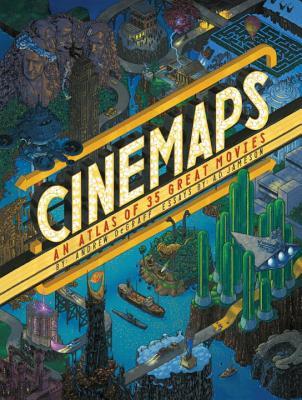
So the reason that I picked up this book originally is because I thought it might be a good birthday gift for a friend. Before I bought it I picked it up from the library so I could flip through it to see what I thought. The book's real showcase is supposed to be the maps, but I thought they were kind of meh at best and confusing and dumb at worst. The saving grace of this book were the great essays that accompanied each of the maps. (It's kind of funny, I thought maybe I was just being a snob about the maps - I have strong feelings about good maps, it's a weird thing I have, okay? - but a lot of the goodreads reviews I read after the fact shared similar sentiments.) The chapter headings on each of the the movies are also beautifully illustrated. I had a soft spot for the Raiders of the Lost Ark one specifically.
-Did you know that Star Wars Episode V: The Empire Strikes Back was delayed filming because Kubrick's shooting schedule for Godfather went long and he took up so many sets on this film lot? Those are two pretty famous movies shot back to back in one spot.
- There is this big link between James Bond and Indiana Jones that I never really put together before but now that I know about it it seems pretty obvious. But I love me some Indiana Jones (if Radiers or Last Crusade is on TV I will stop everything I am doing to watch it until the end) but James Bond always just seems like a whiny prick. Indiana doesn't need gadgets, HE USES BOOKS AND HIS FISTS.(Another thing that I never put together with Raiders and Last Crusade is that Indy and Marian are both fulfilling the dreams of their father's - Marian's was the grail and Henry Sr. the Ark). Good grief now I have go to watch those movies.
-John McTiernan diercted Predator and Die Hard, and they are each other's opposites. John McClane is the Predator taking out a lot of people in one confined place in Die hard.
-In Edward Scissorhands there's a lot of talk about ambrosia salad - "Ambrosia salad is a metaphor for the subdivision. Supposedly divine, it's in fact a sickeningly sweet concoction filled with colored marshmallows that resemble the suburb's houses, squat and identical except for their garish pastel paint jobs."
The Visitors by Catherine Burns. This was a short, fast moving little book that I had heard some buzz on, so I picked it up from the library. The big twists you could kind of see a mile away. It was less than 300 pages I read it in one sitting of maybe an hour and a half.
Mary Reilly by Valerie Martin. I have a weird love/hate on the modern novels that riff on classic novels and/or are fairy tale retelling. I've come to accept a lot of times that these will just be YA love stories (and if you love that, yay good for you!) I indulge in that genre occasionally but usually I want something more fleshed out and substantial. This WAS more fleshed out and substantial. I like the realistic grittiness and complications. And all the discussions about the duality of man's nautre, because of course, Dr J and Mr. H!
Reading people: how seeing the world through the lens of personality changes everything by Anne Bogel. I always think I like personality books but then it's a little bit too much self reflection. Like how for ennegrams I'm a 2, and that means I can be possessive of my friends and it ruined my whole month when I saw that, because I thought one of my few good traits was that I'm a super supportive and loving friend and now every time I do something nice for a friend I'm like "am I doing this because this is how I express my love for them or because I'm trying to take ownership of them in some way?" and it makes me have a little mini meltdown. So, this book might be good if you aren't an emotional, possessive of friends, mess like I am.
The Bravest Battle: The 28 Days of the Warsaw Ghetto Uprising: Dan Kurzman
I knew some things about the Warsaw Uprising but not as much as I should. And now I feel like I know a lot of things and they will all haunt me forever. There's so many tales of courage and bravery and self sacrafice in this book, I can't even do it justice. There are also a lot of descriptions of people being burned alive and dying in sewers. It was another one of those reads that was tough but necessary.
The Science of Evil: On Empathy and the Origins of Cruelty by Simon Baron-Cohen. This was such a succinct, easy to read book on a tough topic. It talks about that lack of empathy doesn't make you evil (a lot of folks on the autism spectrum struggle with empathy) but a lot of people who don't have empathy are capable of doing pretty terrible things (hello Nazis) OR people who have a lot of empathy are still capable of doing bad things when they feel like it's for the right reason.Really interesting read!
Mem by Bethany C Morrow
I thoroughly enjoyed this book and was shocked that this is this author's debut. I feel like it's one of those books that the less you know about it going in the better, because the concept is just so interesting and weird and great that it spoils it a little if you try to do a lot of detective work on it before reading. So, read the synopsis on goodreads and if it sounds intriguing to you you will probably like this book! Pick it up!