Tuesday, February 27, 2018

Book review: "Get Well Soon: Histories Worst Plagues and the Heroes Who Fought Them" by Jennifer Wright

I feel like my 2018 is off to just an amazing start reading wise.


via GIPHY

#sorrynotsorryforthehugegifGalgetswhatshewants

So the book we talked about last week about Churchill and Orwell was fo' sho' my favorite book of the year so far until I glanced my peepers with the beauty and Winnie and George have a run for their money. I love me nonfiction, and then I love weird medical nonfiction, especially the really just gross gory stuff. Remember how I talk about that book I read that was all about Rabies like 5 years ago.(So good, so informative, so gross) this book is going to be like that. Except it's a bunch of bad things instead of just one. What puts this book over the top is that while it is informative and interesting it's also FUNNY AS HELL. I lol'd SO many times reading this book. (Usually in the lunch room with coworkers and then I have to explain what the book was about and what was funny and usually that would be weird but they are all scientists and weird is what they do.

So this book talks about (among other things) lobotomies, cholera, typhoid, polio, THE plague, and leprosy. And I know I just did this with the last book but I'm going to just tell you about a bunch of neat shit I learned.

First I'm just going to give you a sample of the hilarious writing style: "Commodus changed his  name because his brain was full of dumb ideas and positive reinforcement. He spent the rest of his time poisoning perceived political enemies and killing extremely nonthreatening animals in gladiatorial games..he killed an ostrich and paraded it proudly before the senators, who had to restrain from laughter". 

-There's a whole section on dancing plagues and I'm obsessed (still). Send me all your book reccs on dancing plagues.Though there is a sad part in that chapter that talks about how mass hysteria can be connected to trauma. Like during the Khmer Rouge killing fields in the 70s so many people developed hysterical blindness because of the trauma they had witnessed.

-The whole section on smallpox will get you riled up about smallpox AND colonization. "Today it is estimated that smallpox killed around 90% of the native people of the Americas".

-My favorite chapter (such a weird thing to say, sorry, continue) was the chapter on syphilis. So many people had syphilis (Schubert, Guy de Maupassant) . Tertiary syphilis is one of the most terrifying things you can have I'm pretty sure. If you have REALLY bad, untreated syphilis your nose can just, sink into your face and rot off.

- Best line from the typhoid chapter: "The good news is that now we know that TB isn't a cool blessing. We don't look at a woman with consumption and think, Oh, man, she is withered like a ghost and spitting blood; I want her to be my Victorian bride!"

In (not so) short, this book is my jam. It is my jammiest jam and I loved it. I already have another of this author's books on hold and I can't wait to get my grubby hands on it. 4/5 would recommend to a weird, gross friend like me! 


30199426


Thursday, February 8, 2018

Book review: Churchill & Orwell - The Fight for Freedom" by Thomas E Ricks

I know that it is dangerously early in the year to be saying something like this, but I think that this is going to be one of my favorite reads of the year! When I would describe this book to people I think most of them thought I was reading it under threat of violence (it sounds a little intimidating, fair enough) but it was a really enjoyable and fast moving read.

Churchill and Orwell are not people that you would probably put together at first glance, politically they would disagree on some fundamental things, they came from very different stations in life, etc. But the things that formed them as men were pretty similar: absentee fathers, near death experiences as young men that changed the course of their lives, family tragedy and at the forefront for this book, the Second World War.(If you, like my husband, saw Darkest Hours and went on a binge of "I never gave a shit about Churchill but now I have to know everything about him!" this would be a good book for you as well). 

Im going to give you the 5 most interesting things that i learned form this book and I hope that it will encourage you to pick it up for yourselves:

1. George Orwell had no brothers, ironic considering he created Big Brother
2. George Orwell was obsessed with how things smelled. A lot, like borderline too many, of his descriptions of his books are about setting the scene with how things smelled
3. Churchill wore pink silk underwear
4. Churchill thought that the French government failed their people in a HUGE way during WWII (and England, with the French under the Nazi thumb it was just a hop, skip and a jump to England) and he was pissed about that for the rest of his life. Major French anger.
5. Right before the D-DAY invasion there were 1.6 million Americans in England

The amount of post it notes I had in this book was insane, it was chalked full of interesting bits and stories. Highly recommended, 4 out of 5 stars. 5/5 for the simple, elegant, regal cover.


Image result for churchill and orwell

Wednesday, January 31, 2018

Book Review: "The Moon is Down" by John Steinbeck

This is another one of those books that I don't remember how it ended up on my TBR but I am glad that it did.


This book is about a quiet, costal town that is swiftly and nearly bloodlessly occupied by an invading force. The townsfolk start by being a little befuddled and confused by the whole thing, but then are consumed by a "slow, silent, waiting revenge". (Might have something to do with the fact that they are being forced to work in the town's coal mines, you know?)

The young men in the occupying force are confused in a different way. They imagined occupation to be quiet, obedient citizens who won't put up much of a fight against their new overloads and do what they are told. They might even be secretly happy to have this new regime in charge. And the girls, well who DOESN'T love a man in uniform?

That's not what happens.

After a short time the townspeople take any opportunity to murder an unaware soldier. It doesn't do much for troop morale. (And while, obviously it was dumb and naive of the occupiers to be like "oh my gosh they are going to think it's great that we are here" I thought it was interesting to hear the soldier perspective about how incredibly lonely and isolated they felt).


Let's be clear about this book: though nothing is ever named specifically, this book is about Nazism. There are specifics named in the prologue but it was written during WWII (and was in fact banned by the Nazis). The book had to be smuggled into Norway (that Quisling, what an asshole) which is also the presumed setting of the book. The prologue has a lot of great stories about the "life" of this book, don't skip it!

This slim novel was a great re-introduction to Steinbeck for me (I'd only ever read Grapes of Wrath and Mice & Men) and I've actually started another little novella of his, Cannery Row, because I liked this book so much. 3.5 out of 5 stars!


12722

Monday, January 22, 2018

Rapid Fire Mini Reviews - 12

"Ether Day: The Strange Tale of America's Greatest Medical Discovery and the Haunted Men who Made It" by Julie M Fenster.

I wanted this book to be awesome but it was pretty boring. Which is surprising because it gets really gory about surgery pre-anesthesia, about three men all contending they invented the same thing and the fact one of them has a mastadon skeleton in his house. Though there was one really great line I loved: "An operation without anesthesia was nothing more than trauma at the top of the hour: on a schedule".

"Of Mess and Moxie: Wrangling Delight Out of This Wild and Glorious Life" by Jen Hatmaker

I love me some Jen Hatmaker. I truly do. I always am right at the top of the holds list when she has a new book out. This book was fine. I just feel like it's kind of like all of her other ones. (Except for 7, which I love the most and is very different.) I feel like you could put the text of most of her books in a bucket and shake it and pull out a chapter and it could be from any number of books. It's all very agreeable it's just not really different from any other thing she has done. 

"Hex" by Thomas Olde Heuvlt
I read this spooky book right around Halloween. There are some flaws with this book for sure (it's a little heavy handed with the imagery and the dad is an idiot) but the concept of a witch that was murdered during colonial times that haunts a modern cursed town was an interesting concept to me.

"The Archivist's Story" by Travis Holland
This is the story of a youngish man who was an English professor in Stalin's Russia who then begins work in the archives of the dreaded Lubyanka. He's not a true believer but toes the party lien until he comes across a prisoner, a man who is an author he admired and comes into the possession of the author's last, unfinished manuscript. I think what made this story most interesting was the day to day drudgery and struggle of people under this regime.


75041


"Apollo 8: The Thrilling Story of the First Mission to the Moon" by Jeffrey Klugger
If you have an interest in space and want to lean a lot without being bogged down by all the nitty gritty details of math and mechanics, this is the book for you! It covers so much more than just the titular apollo mission. Such a great read. I watched Apollo 13 (for the 100000th time) a few days after finishing this book and I kept pipping in with new little nuggets of information I had learned and didn't annoy my husband at all.

Wednesday, November 8, 2017

Amsterdam!

My sister Quinn and I embark on our next European adventure in about a week! I'm super excited obviously. We have a pretty packed and detailed itinerary since our trip won't be that long and I can't wait to tell you all about it when we get back!

I'm actually reading a book right now called "The Last Seven Months of Anne Frank" by Willy Lindwer. It's about, well the last seven months of Anne's life. It's interviews with people who, in general, knew Anne in "real life" and then ended up in the same concentration camp(s) that she was in. It's interesting because of the tie in to Anne but the first hand witness accounts would be able to stand on their own.

If anyone has read anything good (and maybe light and in paperback!) that would be good for airport reads let me know! Packing the reading is one of the most important parts of packing :)


Friday, November 3, 2017

Book Review: "The Book Thieves: The Nazi Looting of Europe's Libraries and the Race to Return a Literary Inheritance" by Anders Rydell

It's not a secret that when the Nazis tore through Europe they helped themselves to mostly anything that they wanted and destroyed whatever they didn't want. I think with the suceess of Monuments Men (book and movie) people mainly think about this in terms of art. But what about books? That's what this book focuses on.

The Nazis didn't just steal books from wealthy individuals personal collections (which of course they did) but also institutional libraries, like rabbinical schools. A lot of these books were either studied or kept (like to be put in Hitler's museum of "Oh my gosh, look how backward the Jews were, aren't you glad we eradicated them?") or destroyed. "And in the little town of Herford in Western Germany, children used them (Jewish sacred texts) to make confetti for a folk festival".

The author travels to the sites where these libraries and personal collections used to be  and places where restitution is trying to take place. A lot of these books after the war were either just let to rot somewhere or were absorbed by local public libraries, including some big ones in Berlin. Now librarians have the Herculean task of going through the books and seeing if there are any clues on who they belonged to so that they can get the books back the right families. (A lot of this information is being digitized and put on the internet, and they are hoping that people will go looking for this information when they start doing research on the family tree.)


Im always curious about the stories of countries that were invaded by the Nazis that you hear less about, some good examples being Greece and the Scandanavian countries. This book has some heartbreaking stories about some Greek Jews. Anyone have any book reccs on these settings?


Did you know that no Guttenberg Bible has been for sale since the 1970s but the estimated current market value is $35 million?


Really, my only complaint about this book is that it had a lot of background information about the Nazis. This in an of itself was not a bad thing, but if you're a person reading this book you probably have a pretty solid background on that group and don't need it re-explained. Like, if you're just starting to read books about WWII this probably isn't the book you're reaching for. If that makes sense.


30212470

Monday, October 23, 2017

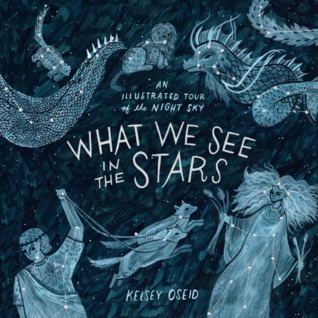
My 5 favorite things I learned from "What We See in the Stars: An Illustrated Tour of the Night Sky" by Kelsey Oseid

I often talk about how much I love me some space travel. I always cry at the same parts of Apollo 13, etc. etc. However, what I lack is a basic understanding of what makes the space that we travel through what it is. I also never try to present myself as a learned student of the sciences because I'm just not. So when I saw this pretty little hardcover on the Blogging for Books website I said "Self, let's get some education about this amazing place where we live". And I did.

Here are my  5 favorite things I learned from this book:

1. Do you ever think "Uh, I dont know why they named Ursa Major after a bear because that is literally just a string of stars that looks nothing like a bear". The answer might be: false pattern recognition.


2. Did you know that Uranus has 27 moons? And I feel like so many of them are named after Shakespeare characters or Shakespeare characters were named after them, whatever. (Miranda, Oberon, Titania)

3.Did you know that shadows cast on the moon are MUCH darker than shadows cast on earth?

4. When the moon appears to grow is waxing. When it looks like it's shrinking it's waning. (I feel like that should be basic moon 101 but I was not 100% on that)


5. When people talk about the Dog Days of Summer its a reference to Sirius, when the sun and Sirius rise at about the same time aka during some of the hottest days of summer.


In addition to being full of awesome, helpful facts - the illustrations are beautiful, clear and helpful. I want the pretty, smudgey background of all of the pages to be my desktop wallpaper. 

Beautiful, interesting and informative. If you have even half of an inkling to pick this book up you should!


33897637
I received this book for free in exchange for an honest review from Blogging for Books